Can You Combine EMS Training With Weight Training and Cardio?
19 October, 2026
If you already lift weights, run, cycle or do other cardio, you may be wondering how EMS fits into your current routine. Should it replace part of your training, or work alongside it?
The good news is that you do not necessarily have to choose one approach over the other. EMS can complement traditional exercise when it is planned around your goals, fitness level and recovery needs.
EMS fitness training can be added as a structured session within your weekly routine. For some people, it provides an efficient way to include another focused workout, especially when time is limited.
So, can you combine EMS with weights and cardio?
Yes. You can combine EMS with weight training and cardio. The key is understanding what each type of training does, spacing sessions sensibly and giving your body enough time to recover.
In this blog, we’ll explain how EMS Australia can fit with weight training and cardio, when it makes sense to separate sessions, how much recovery to allow and what a practical weekly schedule can look like.
How EMS Training Works Alongside Traditional Exercise
Electrical muscle stimulation in Australia, or EMS, uses controlled electrical impulses to stimulate muscles while you perform guided movements.
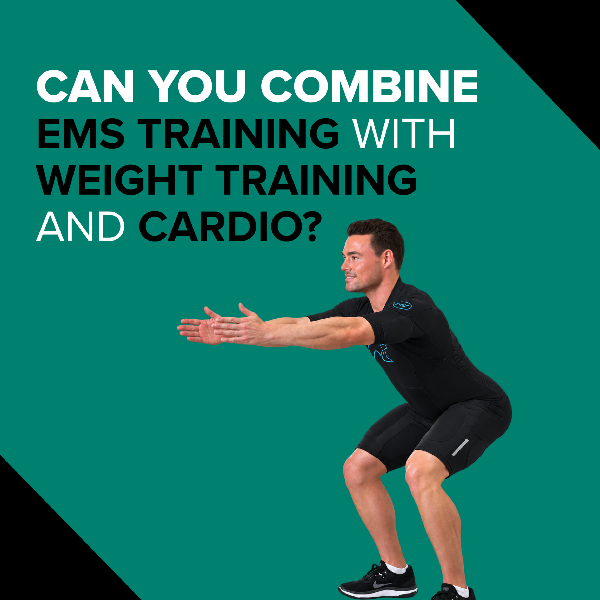
During an EMS fitness training session, you typically perform bodyweight exercises such as squats, lunges, rows, planks and core movements while wearing an EMS suit. The system provides additional muscle activation as you move.
EMS exercise in Australia is not simply another traditional gym session. It adds external muscle stimulation to controlled exercises, creating a different type of training stimulus.
Research into electrical muscle stimulation suggests that EMS may support improvements in muscle strength, body composition, and muscle tone when used appropriately.
EMS does not need to replace the exercise you already enjoy. Instead, it can work as another tool within a balanced training routine, especially when it is planned around recovery and consistency.
Can You Do EMS and Weight Training Together?
Yes, but the way you combine EMS and weight training is important.
Weight training uses progressive resistance to build strength and muscle over time. As you improve, you can increase the weight, repetitions, sets or exercise difficulty to keep challenging the muscles.
EMS technology in Australia stimulates the muscles while you perform controlled movements, adding another layer of muscle activation to the session.
These are different training methods, but they can complement each other. Research has found that combining resistance training with electrical muscle stimulation may produce greater improvements in strength and muscle mass than resistance training alone.
A practical approach is to use weight training as your main strength-training method, then add one or two EMS sessions per week to support deeper muscle activation and target harder-to-reach muscle groups.
The key is to allow enough recovery between sessions and avoid turning every workout into a maximum-effort session.
EMS vs Weight Training: What Does Each One Do?
EMS and traditional weight training are not necessarily competing options. You do not have to choose one and give up the other.
Weight training helps build strength, increase muscle size and improve performance by progressively overloading the muscles with external resistance.
EMS Australia uses electrical stimulation to activate muscles while a trainer guides you through controlled exercises. The suit provides a strong stimulus in a short session, which can appeal to time-poor clients or people looking for a low-impact training option.
Because EMS adds external muscle stimulation while you perform low-impact movements, it can provide additional muscle activation without placing the same external load on the joints as heavy resistance training.
Rather than asking which method is better, it is more useful to ask which combination best fits your goals, schedule and recovery needs.
Can EMS Training Be Combined with Cardio?
Yes. Cardio and EMS can work together as part of the same training program.
Cardio helps support cardiovascular health, endurance and lung capacity.
EMS technology in Australia may also support endurance by helping activate slow-twitch muscle fibres used in endurance activities.
For example, your week could include:
– One EMS session
– One or two traditional strength training sessions
– Walking, swimming or running
– Rest days or lighter movement days
Spreading sessions throughout the week can help manage fatigue, support recovery and make your routine easier to maintain.
Should You Do EMS Before or After Weight Training?
Both EMS fitness training and weight training are high-intensity workouts that place demand on the body, so it is important to allow enough time for muscle recovery between sessions.
For this reason, we recommend separating sessions and avoiding heavy weightlifting on the same day as your EMS session. However, light cardio such as walking or swimming is usually fine.
The aim is not to fit as much exercise as possible into one day, but to train consistently while giving your body enough time to recover.
How Often Should You Combine EMS, Weights and Cardio?
How often you combine EMS, weights and cardio depends on your goals, fitness level and schedule.
Someone who is new to exercise will usually need a different training frequency from someone with years of training experience.
For Electrical muscle stimulation Australia, starting with one session per week is often recommended. Because EMS can create a strong muscle stimulus, it is important to allow enough recovery between demanding sessions.
If you want to combine different training styles, a balanced weekly routine might include one EMS session, two to three strength training sessions and two to three cardio or active-recovery sessions.
Can EMS Make a Short Workout More Time-Efficient?
This is one of the main reasons EMS Australia appeals to many Australians. A typical EMS fitness training session takes around 20 minutes. For busy Australians, this can make it easier to fit structured exercise into the week.
Instead of thinking, “I don’t have time for a two-hour gym session,” you can ask, “Where can I realistically fit 20 minutes into my week?”
EMS offers another option for people who find that lack of time is one of the biggest barriers to regular exercise.
Combining EMS With Exercise for Muscle Strength
You can perform strength exercises while using EMS technology in Australia. EMS adds extra muscle stimulation as you move through the exercises. Your trainer will guide your technique, stimulation settings, training frequency and recovery needs.
By helping activate deeper and less-used muscles, EMS can make strength training more targeted and efficient.
Combining EMS With Cardio for Overall Fitness
Strength is only one part of overall fitness.
Cardiovascular health is just as important as strength.
EMS Australia can complement cardio rather than replace it.
For example, you might do a short, structured EMS session focused on strength, then walk or cycle on another day.
You could also maintain your regular cardio routine and add one or two EMS sessions during the week.
This can be especially helpful if you enjoy cardio but want to add more resistance-based training without extending your gym sessions.
How Recovery Changes When You Combine EMS With Other Training
This is probably the part that people overlook.
When you combine different forms of exercise, you’re also combining training stress.
Although EMS exercise Australia is a short workout, it is still a high intensity one, and it should count towards your overall training load.
Allowing ample time for recovery is essential. Recovery can include getting enough sleep, eating enough protein and maintaining good overall nutrition, staying hydrated, incorporating easier training days, and paying attention to muscle soreness and fatigue.
EMS Australia doesn’t have to be an alternative to everything else you enjoy.
A balanced week might include EMS for short, structured strength-focused sessions, weight training for progressive resistance, cardio for cardiovascular fitness, and easier days for recovery. The best combination is the one that supports your goals, fits your schedule, and leaves you able to train consistently.
For someone who loves lifting weights, EMS may be an additional training option.
For someone who mainly does cardio, EMS can add a resistance-focused session to the week.
And for someone who struggles to find time for exercise, a short EMS session can be a practical way to fit structured training into a busy schedule.
The important thing is to look at your overall training week, rather than focusing on one workout.
Train hard when appropriate. Keep some sessions easier. Give your body time to recover. And choose the combination that you can realistically maintain.
FAQ
Can I do EMS and weight training on the same day?
It is generally recommended to avoid doing EMS fitness training and weight training on the same day. Both types of training can place significant demands on the muscles, so separating them can make it easier to manage fatigue and allow adequate recovery.
Should I do EMS before or after cardio?
It depends on your goals and the intensity of the cardio session. If cardio is your priority for that day, you may prefer to do it when you’re fresh.
Can EMS replace weight training?
EMS exercise in Australia can be a useful training option if you are short on time, but it does not necessarily have to replace weight training. The best approach may be to combine the two, depending on your goals, training experience and recovery needs.
Can I do cardio after an EMS workout?
Yes, you can, but consider the intensity and duration. A light walk or an easy cardio session may be more suitable. We recommend avoiding high-intensity interval training on the same day as an EMS workout.
How many days a week should I combine EMS and weight training?
There is no specific schedule that works for everyone. It depends on your goals, training experience, recovery needs and the time you have available. In general, one to two EMS sessions per week can be a useful addition to your training routine.
Is EMS better with weight or cardio?
It really depends on what you are trying to achieve. EMS is naturally suited to resistance-style movements when your focus is strength, while cardio can complement EMS by targeting cardiovascular fitness and endurance. All three can have a place in the same weekly routine.
Can EMS and traditional exercises be used together for strength?
Yes. Research has specifically investigated EMS combined with voluntary resistance training, and some studies report additional strength and muscle benefits when the two are combined.
For people looking for EMS in Australia, the biggest advantage may simply be having another training option. You don’t have to give up your favorite workouts to try EMS. You can lift weights, go for a run, ride your bike, play sports, and still include EMS in your weekly routine.
The goal is not to do more exercise just for the sake of doing more. It’s about finding a training routine that works with your goals, your schedule, and your ability to recover.
If you’re interested in trying electrical muscle stimulation in Australia, EMS training can be a simple way to add a short, structured workout to your week.
At 20PerFit, EMS sessions are designed around controlled movements and personalized stimulation, with sessions taking around 20 minutes.
Want to see what EMS feels like for yourself? Call 1300 202 073 or get in touch with 20PerFit to book an EMS session.